
 Main Website

What are the key components of a large mining excavator?
Large mining excavators are essential heavy-duty machines used in open-pit mining, quarrying, and large-scale earthmoving operations. Designed for harsh working conditions, they provide powerful excavation and loading capabilities to improve mining productivity and operational efficiency.
However, excavator performance depends not only on machine size or bucket capacity, but also on the quality and integration of key components, including the engine, hydraulic system, working equipment, undercarriage, and control systems. The right component configuration directly affects productivity, reliability, and long-term operating costs.
This article explains the key components of large mining excavators, their functions, and how they influence equipment performance, helping mining professionals evaluate equipment configurations and make informed equipment selection decisions.
1. Quick Answer
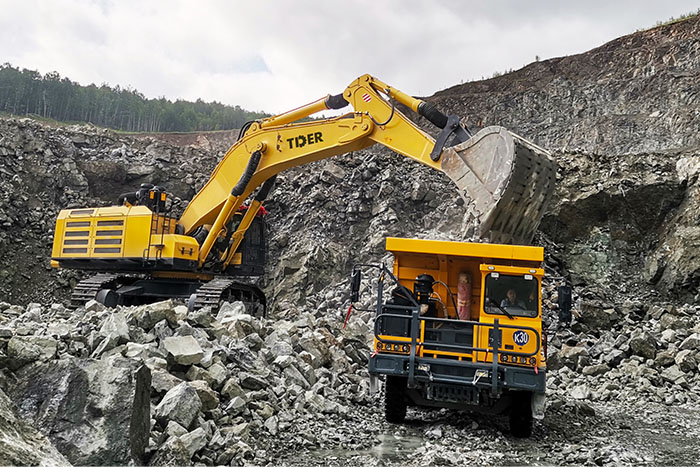
Large mining excavators consist of several key components, including the engine and power system, hydraulic system, boom and arm assembly, bucket, swing system, undercarriage, electrical control system, and operator cabin. These components work together to determine the excavator’s digging performance, productivity, reliability, and operating efficiency in demanding mining environments.
2. What Are the Key Components of a Large Mining Excavator?
A large mining excavator consists of multiple systems that work together to provide excavation power, loading efficiency, and long-term reliability. Each component plays a specific role in determining machine performance, especially under continuous heavy-duty mining conditions.
Engine and Power System
The engine and power system provide the energy required for excavation, loading, swinging, and traveling operations. In large mining excavators, a powerful and reliable engine is essential for maintaining stable performance during long working cycles.
Key factors such as power output, fuel efficiency, reliability, and maintenance requirements directly affect operating costs and productivity.
Hydraulic System
The hydraulic system is one of the most important components of a large mining excavator. It transfers engine power into hydraulic force to control the boom, arm, bucket, and swing movements.
A high-performance hydraulic system improves digging force, operation smoothness, and multi-function capability, allowing the excavator to maintain efficient performance in demanding mining environments.
Boom, Arm, and Bucket Assembly
The boom, arm, and bucket form the main working equipment of a mining excavator and directly perform excavation and material handling tasks.
These components must withstand high impact loads, abrasive materials, and continuous operation. Their structural strength, wear resistance, and bucket capacity directly influence excavation efficiency and equipment durability.
Swing System
The swing system enables the upper structure of the excavator to rotate between excavation and loading positions.
A reliable swing system helps reduce cycle time, improve loading efficiency, and maintain stable operation during repeated excavation and truck-loading processes.
Undercarriage System
The undercarriage supports the entire machine and allows the excavator to operate on uneven and challenging mining terrain.
It includes components such as the track frame, track chains, rollers, and drive system. A durable undercarriage design improves machine stability, mobility, and service life in harsh mining conditions.
Electrical and Control System
The electrical and control system manages machine operation, performance monitoring, and fault diagnosis.
Modern mining excavators use advanced control systems to improve operating efficiency, reduce downtime, and support easier maintenance management.
Operator Cabin and Safety System
The operator cabin provides the working environment for machine operators during long-hour mining operations.
A well-designed cabin improves visibility, comfort, and operational safety through features such as ergonomic controls, protective structures, and monitoring systems.
3. How to Choose a Large Mining Excavator Based on Component Requirements?
When selecting a suitable large mining excavator, buyers need to consider factors such as mining conditions, production requirements, machine performance, maintenance costs, and total ownership costs. A proper excavator configuration can improve mining efficiency, reduce downtime, and provide better long-term operating value.
Specific selection criteria are as follows:
Mining Scale and Working Conditions
The excavator size and configuration should match the mining scale, production requirements, and working conditions.
Large open-pit mines with high production demands typically require 70-ton or larger mining excavators to provide higher digging performance, larger bucket capacity, and efficient loading capability for high-capacity mining trucks.
Medium-sized mines, quarries, and heavy excavation projects commonly use 30–70 ton crawler excavators, offering a balance between productivity, flexibility, and operating costs. Smaller configurations may be more suitable for projects with limited working space or lower production requirements.
Material conditions also influence equipment selection. Hard rock applications require reinforced structures and wear-resistant components, while softer materials often prioritize larger bucket capacity and loading efficiency.
Core Excavator Performance Parameters
Key performance parameters directly affect excavation efficiency, productivity, and long-term operating costs.
Focus on digging performance and production capacity. Bucket capacity, digging force, and working cycle speed determine how much material the excavator can handle in each cycle and whether it can meet project production requirements.
Consider power and hydraulic performance. A properly matched engine and hydraulic system provide stable performance during continuous heavy-duty operation while helping reduce fuel consumption and downtime.
Evaluate durability for mining conditions. The strength of working equipment, undercarriage reliability, and component durability are important for reducing maintenance frequency and ensuring long-term operation in harsh environments.
Maintenance Conditions and After-sales Support
Large mining excavators operate under demanding conditions, making maintenance support an important factor in long-term equipment performance.
Buyers should consider whether key components are easy to inspect and maintain, as convenient maintenance can reduce service time and operating costs. The availability of spare parts, technical support, and local maintenance resources should also be evaluated before purchase.
A reliable after-sales system, including warranty coverage and timely service support, can help minimize equipment downtime and improve the long-term return on investment.
Total Operating Cost and Investment Value
The initial purchase price is only one part of the investment decision. Buyers should evaluate the total cost of ownership, including fuel consumption, maintenance expenses, component replacement, and equipment service life.
A machine with reliable components, efficient operation, and lower downtime can provide better long-term value even if the initial investment is higher.
4. TDER TCE1000: A 100-ton Mining Excavator for Heavy-duty Mining Operations
TDER TCE1000 is a 100-ton class crawler excavator designed for demanding mining applications, including open-pit mining, coal loading, stripping operations, and large-scale earthmoving.
The machine integrates high-power performance, efficient hydraulic technology, reinforced structures, and intelligent control systems to meet the requirements of continuous heavy-load operation in harsh mining environments.
High-power Performance for Continuous Mining Operations
The TCE1000 is equipped with a Scania DC16 high-power engine, delivering 574 kW at 2,000 rpm to provide strong power output for heavy excavation tasks.
Combined with ECO mode and an efficient hydraulic system, the excavator achieves strong digging performance while improving fuel efficiency. The engine also requires no urea addition, helping reduce operating costs and simplify maintenance.
Its high-altitude adaptation technology and enhanced cold-start capability allow reliable operation in challenging environments.
Efficient Hydraulic System for Higher Productivity
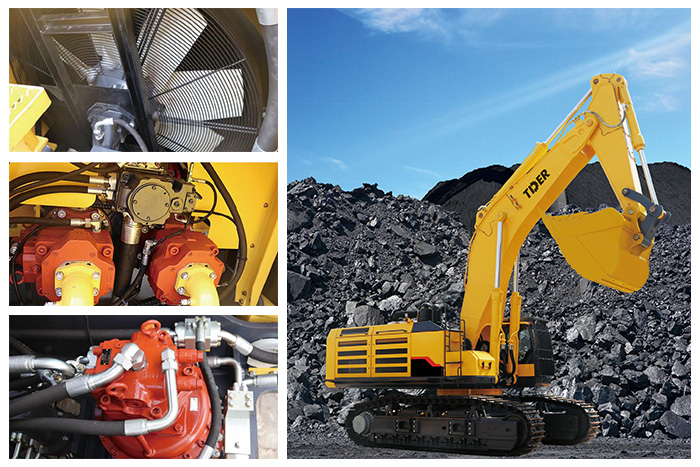
The TCE1000 adopts a Kawasaki positive flow hydraulic system with a 280cc dual-pump design, providing faster response, stronger digging force, and smoother coordination between working movements.
Its independent dual cooling system separately controls oil and water cooling, improving heat management and reliability during continuous heavy-duty operations, especially in high-temperature or harsh mining environments.
Reinforced Structure for Harsh Mining Conditions
For demanding mining applications, structural durability directly affects equipment availability and service life.
The TCE1000 uses reinforced structural components optimized through finite element analysis, with 50% higher load-bearing capability compared with similar models in the same class, improving durability under heavy excavation conditions.
The machine is equipped with a 6.5 m³ rock bucket featuring high-strength wear-resistant plates as standard. Optional 6.5–8 m³ buckets, rippers, hydraulic breakers, and other attachments allow the excavator to adapt to different mining materials and working conditions.
Safe, Intelligent, and Comfortable Operation
Mining excavators often operate for long hours in dusty, noisy, and demanding environments, making operator safety and comfort important factors.
The TCE1000 features a pressurized operator cabin designed for harsh mining environments.
The cabin provides:
- FOG and FOPS protection for improved operator safety
- Enhanced sealing performance to reduce dust and noise
- 10-inch touchscreen display with intelligent monitoring
- GPS remote monitoring and fault diagnosis
- 360° camera system for better visibility
These intelligent features help operators monitor machine status, improve safety, and maximize equipment availability.
Easy Maintenance to Reduce Downtime
For mining equipment, maintenance efficiency directly affects production continuity.
The TCE1000 adopts a large maintenance space design with an independent pump room and power compartment, making inspection and servicing more convenient.
The dual-filter air filtration system also simplifies routine maintenance and helps maintain reliable machine performance during long-term operation.
5. Conclusion
Choosing a large mining excavator requires balancing excavation performance, operating conditions, reliability, and long-term operating costs. The right combination of power system, hydraulic performance, structural strength, and maintenance support helps improve productivity and reduce downtime.
TDER provides crawler excavator solutions from 21-ton to 135-ton classes, including heavy-duty mining models designed for demanding mining applications, helping customers select suitable equipment for different project requirements.
6. FAQs
How do I choose the right tonnage of a mining excavator?
The excavator size should match the mine production requirements, material conditions, and haul truck capacity. Large open-pit mines usually require excavators above 70 tons, while 30–70 ton models are commonly used for medium-sized mines and quarries. TDER offers crawler excavators from 21-ton to 135-ton classes for different mining applications.
Is a larger mining excavator always more productive?
Not always. A larger excavator provides higher production capacity but also requires higher investment, transportation capacity, and operating costs. The best choice is a machine that matches the project requirements, such as TDER TCE1000, which is designed for large-scale mining and heavy-duty excavation.
What factors should be considered when matching a mining excavator with haul trucks?
Customers should consider bucket capacity, loading cycle time, and the number of passes required to fill each truck. A properly matched excavator can maximize truck utilization and reduce waiting time.
When should I choose an electric mining excavator?
Electric excavators are suitable for mines with stable power supply, fixed working areas, and requirements for lower emissions or reduced fuel costs. They are especially considered for large-scale mining projects and environmentally regulated areas. TDER also provides electric excavator solutions for specific applications.
Which excavator components are most important for mining operations?
The engine, hydraulic system, working equipment, and undercarriage are the key components affecting mining excavator performance. Their configuration directly influences digging efficiency, reliability, maintenance requirements, and long-term operating costs.
What should I consider when choosing a mining excavator supplier?
Besides machine performance, buyers should evaluate spare parts availability, technical support, warranty coverage, and after-sales service capability. A reliable supplier helps reduce downtime and improve long-term equipment value.