
 Main Website

Best Wheel Excavators for Urban Construction
Wheel excavators are widely used in municipal projects, road construction, pipeline installation, and infrastructure development because of their mobility, versatility, and efficiency in urban environments.
This article will explore the advantages of wheel excavators, why 21-ton models are suitable for city projects, and how the TDER TWE210 meets the requirements of contractors and equipment buyers.
1. What Are the Best Wheel Excavators for Urban Construction?
The best wheel excavators for urban construction should offer a balance of mobility, digging performance, fuel efficiency, and versatility. For municipal projects, road construction, pipeline installation, and urban infrastructure development, 21-ton wheel excavators are an ideal choice because they offer high productivity while maintaining excellent mobility in urban environments.
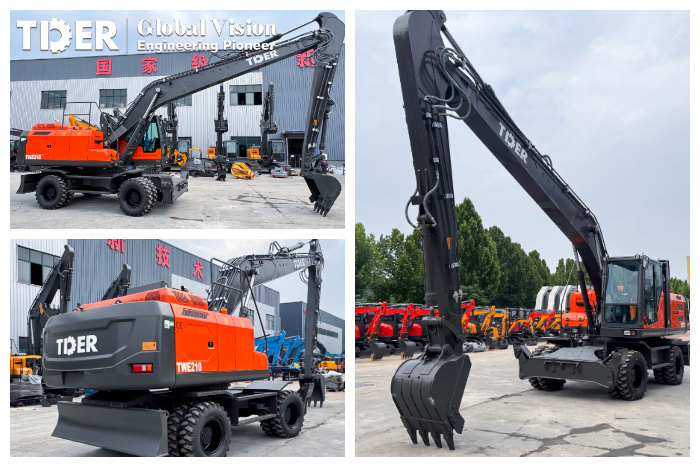
The TDER TWE210 21-ton wheeled excavator is designed for these demanding applications. Equipped with a Cummins 6BTAA5.9 engine, Kawasaki hydraulic system, ZF transmission, and 1.1 m³ bucket capacity, it delivers reliable power, smooth operation, and efficient performance for contractors, engineers, and equipment buyers.
2. Why Wheel Excavators Are Ideal for Urban Construction?
Urban construction projects require equipment that can deliver productivity while adapting to changing job conditions. Compared with crawler excavators, wheel excavators provide better mobility, lower transportation requirements, and greater flexibility for projects involving multiple work locations and paved roads.
(1) Faster Mobility and Lower Transportation Costs
One of the key advantages of wheeled excavators is their ability to move quickly between different job sites. Equipped with rubber tires, they can travel directly on urban roads without frequent transportation by trailer.
This reduces relocation time and transportation costs, helping contractors improve machine utilization and project efficiency, especially for municipal projects, road maintenance, and utility construction.
(2) Reduced Impact on Urban Roads
Urban construction often takes place on existing roads, sidewalks, and developed areas where protecting surfaces is important. The rubber tires used on wheel excavators create less impact on paved surfaces compared with crawler tracks, making them more suitable for operations on asphalt and concrete roads.
This advantage allows contractors to perform excavation, maintenance, and infrastructure work while reducing the need for additional road protection measures.
(3) Versatile Applications for City Projects
With different attachments, wheeled excavators can perform a wide range of urban construction tasks, improving machine utilization and reducing the need for multiple types of equipment.
|
Application |
Typical Work |
Recommended Attachments |
|
Municipal Projects |
Road repair, drainage, and utility construction |
Bucket, Hydraulic breaker |
|
Pipeline Installation |
Water, gas, and communication infrastructure |
Bucket, Hydraulic breaker, Auger |
|
Infrastructure Construction |
Excavation, earthmoving, and material handling |
Bucket, Grapple |
|
Landscaping Projects |
Site preparation, digging, and material handling |
Bucket, Grapple, Auger |
For contractors, engineers, and equipment buyers, wheel excavators provide an effective balance of mobility, productivity, and versatility, making them a practical solution for modern urban construction projects.
3. Key Features to Look for in a Wheel Excavator
Selecting the right wheel excavator requires evaluating more than just the purchase price. Contractors, engineers, and equipment buyers should consider performance, efficiency, reliability, and long-term operating costs.
A high-quality wheel excavator should provide the right balance of power, mobility, fuel efficiency, and versatility for different urban construction applications.
(1) Engine and Hydraulic Performance
The engine and hydraulic system directly influence excavation efficiency, fuel consumption, and overall machine performance. A suitable wheel excavator should provide stable power output, efficient power distribution, and smooth operation under different working conditions.
Key factors to consider include:
- Engine power and fuel efficiency
- Hydraulic system performance
- Digging force and operating smoothness
- Service availability and maintenance support
(2)Operating Weight and Working Capability
Choosing the right machine size is essential for balancing productivity and mobility. A wheel excavator with suitable operating weight, bucket capacity, and working range can improve efficiency while avoiding unnecessary transportation and operating costs.
Key specifications to evaluate include:
- Operating weight
- Bucket capacity
- Maximum digging depth
- Working range
(3)Attachment Compatibility and Operator Comfort
Versatility is another important factor when selecting a wheel excavator. Compatible attachments such as buckets, hydraulic breakers, grapples, and augers allow one machine to handle different construction tasks.
In addition, a comfortable cabin, air conditioning, and ergonomic controls help improve operator efficiency during long working hours.
4. Why Choose a 21-Ton Wheel Excavator for Urban Construction?
Selecting the right excavator size is critical for urban construction projects. A machine that is too small may limit productivity and increase project time, while an oversized excavator can create higher transportation costs and reduce flexibility in developed urban areas.
For many municipal and infrastructure projects, a 21-ton wheel excavator provides the ideal balance between digging performance, mobility, and operating efficiency. It delivers stronger productivity than compact machines while remaining more practical and cost-effective than larger excavators.
(1) Smaller Wheel Excavators: More Flexible but Limited Productivity
Compact wheel excavators are widely used for landscaping, maintenance work, and small-scale utility projects because of their excellent flexibility and easy operation in limited spaces.
However, when projects require continuous excavation, larger working ranges, or higher material handling capacity, smaller machines may face limitations:
- Lower digging force for demanding soil conditions
- Smaller bucket capacity and reduced productivity
- Longer working time for large-volume excavation tasks
- Limited performance in medium-scale infrastructure projects
For contractors handling municipal construction, road projects, and utility installation, a 21-ton wheel excavator provides the additional power and capacity needed to improve overall efficiency.
(2) Larger Excavators: Higher Power but Reduced Urban Flexibility
Larger excavators can deliver greater digging force and higher production capacity, but they are not always the most efficient choice for urban construction.
Oversized equipment may result in:
- Higher transportation requirements between job sites
- Increased fuel consumption and operating costs
- More challenges when working in developed urban environments
- Lower flexibility for projects requiring frequent relocation
A 21-ton wheel excavator provides sufficient performance for demanding construction tasks while maintaining the mobility advantages required for city projects.
(3) 21 Tons: The Practical Balance for Urban Infrastructure Projects
The 21-ton class fills the gap between compact machines and heavy-duty excavators. It offers enough power for medium and large urban construction tasks while maintaining the flexibility needed for efficient operation.
Key advantages include:
- Strong digging capability for excavation and earthmoving
- Larger bucket capacity for improved productivity
- Better mobility compared with heavier equipment
- Lower transportation and operating costs
- Versatility for different attachments and applications
For road construction, municipal projects, pipeline installation, and urban infrastructure development, a 21-ton wheel excavator is often the most practical choice for contractors seeking a balance between performance and long-term operating efficiency.
5. Why Is the TDER TWE210 a Suitable Choice for Urban Construction?
(1) Key Specifications of TDER TWE210
|
Operating Weight |
kg |
21,000 |
|
Engine Model |
- |
Cummins 6BTAA5.9 |
|
Rated Power |
kW |
153 kW / 2,000 rpm |
|
Bucket Capacity |
m³ |
1.1 |
|
Max. Bucket Digging Force |
kN |
140 |
|
Max. Arm Digging Force |
kN |
100 |
|
Max. Digging Depth |
mm |
6,052 |
|
Max. Digging Height |
mm |
10,329 |
|
Hydraulic System Pressure |
MPa |
34 |
|
Transmission |
- |
ZF Fixed-Shaft Transmission |
(2) Key Advantages of TDER TWE210
1) Efficient Mobility for Urban Job Sites
Urban construction projects often require equipment to move between multiple locations. The TDER TWE210 is equipped with a ZF fixed-shaft transmission with electronic shift control, which improves travel smoothness, power transfer efficiency, and fuel economy during frequent relocation.
This allows contractors to reduce transportation requirements and improve machine utilization when working across multiple urban job sites.
2) Higher Productivity with Strong Digging Performance
The TDER TWE210 is designed to provide the working capability required for medium and large urban construction projects. With a 1.1 m³ bucket capacity, 140 kN maximum bucket digging force, and 100 kN arm digging force, it delivers efficient excavation and material handling performance.
The optimized bucket design reduces digging resistance and power loss while extending service life. Compared with similar machines in the same class, the 1.1 m³ bucket provides approximately 10% higher capacity, helping contractors improve productivity in excavation and earthmoving operations.
3) Fuel-efficient Operation with Cummins and Kawasaki Systems
Operating costs are a key consideration for construction equipment buyers. The TWE210 combines a Cummins 6BTAA5.9 engine with a Kawasaki positive flow hydraulic system to achieve efficient power utilization.
The hydraulic system adjusts power output according to working conditions, reducing unnecessary energy consumption while maintaining stable performance during demanding operations. This helps contractors improve fuel efficiency and reduce long-term operating costs.
4) Versatile Performance for Multiple Urban Applications
Urban projects often require one machine to handle different tasks. The TDER TWE210 comes standard with hydraulic attachment pipelines, allowing quick installation of attachments such as hydraulic breakers and other tools without additional modifications.
This enables the machine to support various applications, including road maintenance, concrete breaking, pipeline construction, and material handling, improving equipment utilization and reducing the need for multiple machines.
6. Real Application Case: TDER TWE210 Delivered to Turkey
A Turkish construction company selected the TDER TWE210 21-ton wheel excavator for urban infrastructure and road construction projects. Due to the developed road conditions and multiple job locations, the customer required a machine that could move efficiently between sites while maintaining strong digging performance.
The TWE210 was chosen for its balance of mobility, productivity, and versatility. With CE certification, customized configuration options, and full import process guidance from TDER, the machine provided a reliable solution for the customer’s international equipment purchase.
7. FAQs
What size wheel excavator is suitable for urban construction?
The right size depends on project requirements and working conditions. Compact models are suitable for small maintenance projects, while 21-ton wheel excavators provide a practical balance of digging performance, mobility, and efficiency for municipal projects, road construction, and infrastructure development. Models such as the TDER TWE210 are designed for these applications where both performance and flexibility are required.
Can wheel excavators work on asphalt and paved roads?
Yes. Wheel excavators are designed for urban environments with paved roads. Their rubber tires reduce road impact compared with crawler excavators and allow faster movement between job sites without frequent transportation.
What attachments can be used with a wheel excavator for urban construction?
Common attachments include buckets for excavation, hydraulic breakers for concrete demolition, grapples for material handling, and augers for drilling applications.
What should international buyers consider when importing a wheel excavator?
Buyers should consider machine specifications, certification, component reliability, spare parts support, and supplier experience.
Manufacturers like TDER provide CE-certified equipment, customization options, and import guidance to help international customers complete equipment purchases more efficiently.
8. Conclusion
In summary, selecting a wheel excavator requires considering project requirements, working conditions, and operating efficiency. For urban construction applications, a 21-ton wheel excavator provides a balanced solution for contractors seeking productivity, mobility, and flexibility.
When these factors are combined with reliable components, suitable configurations, and manufacturer support, the equipment can deliver better long-term value. The TDER TWE210 is designed to meet these requirements, providing customers with an efficient and economical solution for urban construction projects.