
 Main Website

What Is a Self-Loading Concrete Mixer?
In construction, infrastructure development, mining, and remote engineering projects, a reliable concrete supply system plays an important role in maintaining productivity and project efficiency. Among various concrete production solutions, the self-loading concrete mixer has become an increasingly popular choice due to its flexibility, mobility, and ability to support on-site concrete operations.
With 23 years of experience in construction machinery manufacturing and international export, TDER has worked with customers in 158 countries and gained extensive experience in different construction environments. Drawing on this industry knowledge, this article explains what a self-loading concrete mixer is, including its working principle, applications, key components, types and sizes, advantages, and selection tips to help contractors, engineers, and project managers choose the right equipment for their projects.
1. What Is a Self-Loading Concrete Mixer?
(1) Self-Loading Concrete Mixer Definition
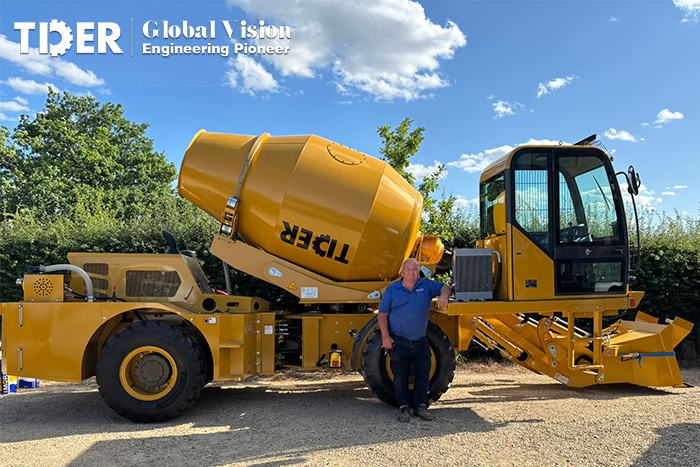
A self-loading concrete mixer is a mobile concrete production machine that integrates material loading, weighing, mixing, transportation, and concrete discharge functions into a single unit. It is commonly used in construction projects, infrastructure development, mining operations, and remote engineering sites, allowing fresh concrete to be produced directly at the job site without relying on external concrete supply, providing greater flexibility and efficiency than traditional concrete supply methods.
For example, TDER self-loading concrete mixers are available with discharge capacities ranging from 0.5m³ to 5.5m³ per batch, providing solutions for applications from small construction projects to large infrastructure operations.
(2) How Does a Self-Loading Concrete Mixer Work?
A self-loading concrete mixer completes the entire concrete production process through several integrated steps, from loading raw materials to delivering fresh concrete at the construction site.
Step 1: Material Loading
The front bucket collects and loads raw materials such as sand, gravel, and aggregates directly from the ground, reducing the need for additional loading equipment and manual labor.
Step 2: Material Weighing
The integrated weighing system measures the required amount of materials to maintain accurate proportions and improve concrete consistency. TDER commonly recommends a weighing display option, allowing operators to monitor material quantities during loading and achieve more accurate mixing ratios.
Step 3: Concrete Mixing
The mixing drum rotates continuously to combine cement, aggregates, and water, producing fresh concrete with a uniform mixture directly at the job site.
Step 4: Transportation
After mixing, the machine transports the fresh concrete directly to the required working area, providing greater flexibility for projects with difficult access or changing construction locations.
Step 5: Concrete Discharging
The operator can discharge concrete directly where it is needed, improving placement efficiency and reducing additional handling during construction operations.
(3) Self-Loading Concrete Mixer vs Other Concrete Equipment
Different concrete equipment serves different project requirements. The main differences are in production method, mobility, installation requirements, and suitable applications.
| Comparison Factor | Self-Loading Concrete Mixer | Concrete Transit Mixer Truck | Concrete Batching Plant | Drum Concrete Mixer |
| Main Function | Produces, mixes, transports, and discharges concrete in one machine | Transports ready-mixed concrete from batching plants | Produces large volumes of concrete through a fixed system | Mixes concrete materials for small-scale projects |
| Production Method | On-site concrete production | Requires ready-mixed concrete supply | Centralized concrete production | Manual or semi-automatic mixing |
| Mobility | High mobility, suitable for flexible and remote operations | Medium mobility, limited by road access and concrete supply | Low mobility, fixed installation required | High mobility but limited working capacity |
| Suitable Applications | Remote construction, infrastructure projects, mining, and small-to-medium projects | Urban construction, commercial buildings, and large projects | Large-scale infrastructure and continuous concrete production |
Small construction projects and repair work |
2. What Are the Main Uses of a Self-Loading Concrete Mixer?
With its integrated concrete production capabilities and excellent mobility, the self-loading concrete mixer can produce and deliver fresh concrete directly at construction sites, improving efficiency and reducing dependence on external concrete suppliers. Its primary applications typically include:
(1) Residential Construction
Used for building houses, small commercial buildings, and residential projects where flexible concrete supply and efficient on-site production are required.
(2) Road Construction
Applied in rural roads, road repair, and infrastructure projects to provide concrete directly at the construction location, especially in areas with limited access to ready-mix concrete suppliers.
(3) Bridge and Infrastructure Projects
Suitable for small and medium-scale infrastructure projects, including bridges, drainage systems, and public facilities that require reliable concrete production.
(4) Mining Operations
Used in remote mining sites for constructing foundations, access roads, support facilities, and other infrastructure where transporting ready-mixed concrete can be challenging.
(5) Remote and Off-Grid Projects
Ideal for construction sites far from urban areas or concrete batching plants, providing an independent concrete production solution without relying on external supply chains.
3. Key Components of a Self-Loading Concrete Mixer
To achieve efficient operation, it is important to understand the key components of a self-loading concrete mixer, as they directly affect the machine’s productivity, reliability, and overall performance.
(1) Engine and Power System
The engine provides power for driving and operating the machine, while a reliable power system helps maintain stable performance and reduce fuel consumption.Depending on project requirements, TDER offers engine options including Cummins and Weichai engines.
(2) Hydraulic System
The hydraulic system controls key functions such as loading, drum rotation, and steering, providing smooth and efficient operation.
(3) Loading Bucket
The loading bucket collects and transfers raw materials such as sand and aggregates, improving loading efficiency and reducing manual handling.
(4) Mixing Drum
The mixing drum combines cement, aggregates, and water to produce fresh concrete with consistent quality directly at the job site.
(5) Operator’s Cabin
The cabin allows operators to control loading, mixing, driving, and discharging operations, improving safety and working efficiency.
4. Types of Self-Loading Concrete Mixers
Apart from the core components, self-loading concrete mixers vary in size, body structure, and cabin design according to different project requirements. They are generally classified by mixer capacity, body type, and cabin configuration.
(1) Size
1) Small Self-Loading Concrete Mixers
Discharge Capacity: Usually below 1.5 m³ per batch.
Suitable for: Residential construction, agricultural projects, small road repairs, and other small-scale concrete applications with limited demand.
2) Medium Self-Loading Concrete Mixers
Discharge Capacity: Generally between 1.5 and 3.5 m³ per batch.
Suitable for: Road construction, commercial buildings, rural infrastructure, and general contractor projects requiring flexible concrete production.
3) Large Self-Loading Concrete Mixers
Discharge Capacity: Typically above 3.5 m³ per batch.
Suitable for: Large infrastructure projects, mining operations, and heavy construction sites requiring higher concrete production capacity.
(2) Body Type
1) Articulated Chassis
Structure: Equipped with an articulated frame that improves steering flexibility and terrain adaptability.
Suitable for: Remote construction sites, mining areas, and uneven working environments.
2) Integrated Chassis
Structure: Built with a fixed-frame design, providing a compact structure and stable operation.
Suitable for: Standard construction sites and projects with relatively flat working conditions.
(3) Cabin Type
1) Fixed Cabin
Design: The cabin remains fixed while only the mixing drum rotates.
Suitable for: General construction projects requiring simple operation and reliable performance.
2) Rotating Cabin
Design: The cabin rotates together with the drum, usually up to 270°, allowing operators to discharge concrete from different directions.
Suitable for: Confined construction areas and projects requiring greater operating flexibility.
5. What Are the Advantages of Using a Self-Loading Concrete Mixer?
No matter the project type, a self-loading concrete mixer offers several advantages compared with traditional concrete production equipment, especially in the following areas:
(1) High Construction Efficiency
Self-loading concrete mixers combine material loading, mixing, transportation, and discharge functions into one machine, reducing waiting time and improving overall construction productivity.
(2) Lower Operating Costs
By producing concrete directly at the job site, self-loading concrete mixers reduce dependence on batching plants, transportation trucks, and additional labor, helping lower project costs.
(3) Excellent Mobility and Flexibility
With a mobile design, self-loading concrete mixers can operate in remote areas and different job sites, making them suitable for projects with limited access to concrete supply.
(4) Reduced Equipment and Labor Requirements
By integrating loading, mixing, transportation, and discharge functions, self-loading concrete mixers reduce the need for additional equipment and operators.
6. How to Choose the Right Self-Loading Concrete Mixer for Your Project?
Before purchasing a self-loading concrete mixer, it is important to consider project size, concrete demand, working conditions, and machine configuration. Choosing the right model helps improve construction efficiency and control operating costs.
(1) Choose Capacity Based on Concrete Demand
For small projects with limited concrete requirements, a small-capacity model is usually sufficient. Medium and large models are more suitable for contractors, infrastructure projects, and operations requiring higher concrete output.
(2) Choose the Right Type Based on Working Conditions
The right configuration depends on the construction environment and operating requirements. Articulated models are suitable for remote areas and uneven terrain due to their better maneuverability, while integrated models are ideal for standard construction sites with stable working conditions.
For narrow construction areas or projects requiring multi-directional concrete discharge, rotating cabin models are recommended. For standard construction sites with regular discharge requirements, fixed cabin models provide a simpler and more practical solution.
(3)Consider Key Features and Support Services
Buyers should consider factors such as engine performance, hydraulic system reliability, spare parts availability, and after-sales support.
TDER provides flexible configurations, allowing customers to select suitable engine brands and hydraulic components, while offering long-term spare parts supply and service support.
Example Selection Based on Real Project Experience
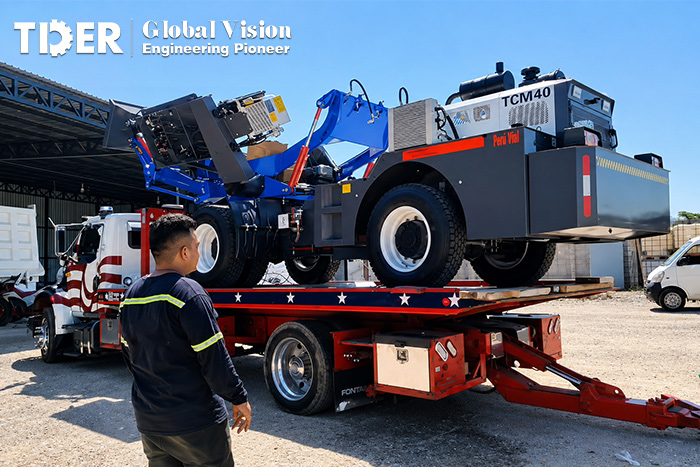
A practical example is a TDER 4m³ articulated self-loading concrete mixer with a rotating cabin used for a road and infrastructure project in El Salvador. The articulated chassis improved maneuverability on complex job sites, while the rotating cabin provided greater flexibility for concrete discharge in different working areas.
7. Customer Case: 4m³ Self-Loading Concrete Mixer in El Salvador
WALTERVENE S.A. de C.V., a construction and engineering company in El Salvador, required a reliable concrete solution for road and infrastructure projects. Based on the project requirements, TDER provided a 4m³ self-loading concrete mixer configured to meet the customer's operational needs. The equipment helped the customer produce concrete directly at the project site, reducing dependence on external concrete suppliers and improving construction flexibility. TDER also provided export guidance and after-sales support to ensure smooth delivery and reliable operation.
8. Conclusion
What is a self-loading concrete mixer? As a versatile construction machine, the self-loading concrete mixer plays an important role in improving concrete production efficiency for construction, infrastructure, mining, and remote projects. In practice, contractors and project managers should select the right model based on concrete demand, working conditions, and project requirements.
As a versatile mobile concrete production solution, it helps contractors produce concrete directly at job sites, especially in remote areas and projects where traditional concrete supply is difficult.
9. FAQs
What does a self-loading concrete mixer do?
A self-loading concrete mixer produces fresh concrete directly at the construction site by loading, weighing, mixing, transporting, and discharging materials.
What is the difference between a self-loading concrete mixer and a traditional concrete mixer truck?
A self-loading concrete mixer adds material loading, weighing, and on-site concrete production capabilities compared with a traditional concrete mixer truck. This allows it to produce fresh concrete directly at the job site without depending on a batching plant or external concrete supply. As a result, self-loading models offer greater flexibility and are especially suitable for remote construction sites, infrastructure projects, and areas with limited access to ready-mixed concrete.
How much concrete can a self-loading concrete mixer produce?
A self-loading concrete mixer’s output depends on the drum capacity, mixing cycle time, and working conditions. TDER offers self-loading concrete mixers with discharge capacities ranging from 0.5m³ to 5.5m³ per batch, with maximum production capacity reaching 20m³/h. Different models are available for various project requirements, from small construction works to road construction, infrastructure projects, and large-scale operations.
What size self-loading concrete mixer do I need for my project?
The right size depends on project scale, daily concrete demand, and working conditions. Small models (0.5m³–1.5m³) are suitable for residential and small-scale projects, medium models (2m³–3.5m³) are commonly used for road construction and general infrastructure works, while large models (4m³–5.5m³) are designed for mining, large infrastructure, and projects requiring higher concrete output.
Is a self-loading concrete mixer suitable for remote construction sites?
Yes. A self-loading concrete mixer is an ideal solution for remote construction sites because it can produce fresh concrete directly at the job site without depending on external concrete supply. Its mobility makes it suitable for rural roads, mining areas, and infrastructure projects with limited access.
Can a self-loading concrete mixer replace a batching plant?
A self-loading concrete mixer cannot completely replace a large batching plant for high-volume continuous concrete production. However, it is a more flexible solution for small-to-medium projects, remote areas, and construction sites requiring on-demand concrete production.